


.png)

The Hidden Cost of Bad Facility Data: What Kraft Heinz’s Digital Twin Use Case Shows Manufacturers

Most facility problems do not start in the field.
They start when teams make decisions from incomplete site information.
In manufacturing, the expensive mistake is rarely the scan. It is the rework. The extra site walk. The vendor quote based on outdated drawings. The equipment move that looked fine in CAD but failed inside the real plant. The maintenance access issue discovered after installation. The safety training that depends on someone walking the floor and explaining everything from memory.
That is the problem Kraft Heinz addressed with facility digital twins.
Capture Now 360 helped Kraft Heinz create digital twins using NavVis technology, giving teams a measurable, navigable, visual record of real plant conditions.
But the real value was not the model itself.
The value was helping teams answer high-impact facility questions before work moved onsite.
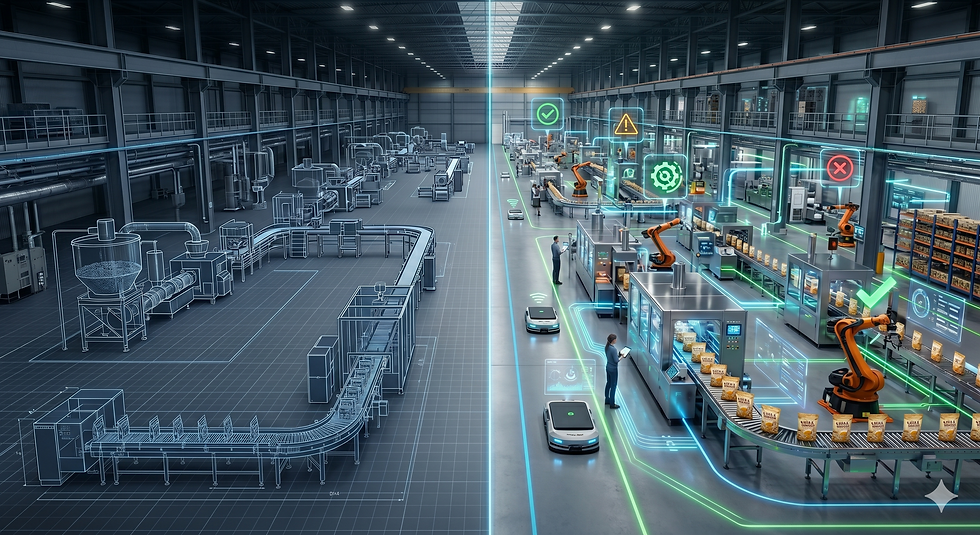
The Problem: Manufacturing Teams Are Often Planning From Incomplete Reality
Manufacturing facilities change constantly.
Equipment gets moved. Lines are reconfigured. Utilities are modified. Maintenance access changes. Vendors come and go. Safety zones evolve. Drawings fall behind.
Over time, the “official” version of the facility can become different from the real one.
That creates risk for teams responsible for:
✅ Engineering and CAPEX planning ✅ Equipment relocation ✅ Maintenance access
✅ EHS training ✅ Logistics and material flow ✅ Vendor coordination
✅ Project scoping ✅ Multi-site operations
When teams do not have current visual site data, they are forced to rely on a mix of drawings, photos, memory, and repeated site walks.
That slows decisions down.
Worse, it creates field surprises.
The Kraft Heinz Use Case: A Digital Twin as a Shared Source of Truth
Kraft Heinz used digital twins to give teams a better way to understand real facility conditions.
The core engineering use case was simple:
Integrate CAD models into the point cloud so project teams could compare planned changes against actual plant boundaries.
That helped Kraft Heinz teams evaluate:
✅ Space Feasibility
Will the equipment or layout fit inside the real facility?
✅ Clearance and Clash Risk
Are there conflicts with walls, platforms, utilities, overhead elements, or nearby equipment?
✅ Maintenance and Inspection Access
Can teams safely inspect, clean, repair, and maintain the equipment after installation?
✅ Material Handling
Can materials, equipment, and people move properly through the plant after the change?
✅ Project Planning
Can teams review the plant virtually before requiring another site visit?
This is where digital twins become more than a “nice visual.”
They become a planning tool.
Why It Matters: The Scan Is Not the ROI. Certainty Is.
A digital twin is valuable because it reduces the number of decisions made from incomplete information.
For manufacturers, that matters because bad facility data can create:
⚠️ Rework ⚠️ Delayed project starts ⚠️ Vendor confusion ⚠️ Repeat site walks
⚠️ Missed clearance issues ⚠️ Unsafe access assumptions ⚠️ Inaccurate scopes
⚠️ Slower approvals ⚠️ Poor cross-functional alignment
Capture Now 360’s manufacturing solutions highlight how NavVis 3D mapping can help manufacturing teams create high-precision digital twins for layout analysis, facility management, virtual inspections, and better operational decision-making.
The business case is simple:
Better facility visibility helps reduce the friction that slows projects down.
For Kraft Heinz, the immediate value was practical.
Teams could see, measure, and validate real plant conditions before work moved into the field.
One Digital Twin. Multiple Teams.
The strongest part of the Kraft Heinz use case is that the digital twin was not limited to engineering.
It created value across multiple functions.
1. Engineering and CAPEX Teams
Engineering teams used the digital twin to validate planned work against real conditions.
That is especially valuable before:
🏗 Equipment relocation 🏗 Line changes 🏗 Vendor scoping 🏗 CAPEX planning
🏗 Retrofit projects 🏗 Layout validation 🏗 Shutdown planning
Instead of relying only on CAD files, photos, or field notes, teams could compare plans against the actual plant environment.
The value:
Fewer field surprises before vendors mobilize.
2. Maintenance Teams
Maintenance teams can use the digital twin as a visual navigation layer.
Instead of relying only on drawings, folders, photos, or tribal knowledge, technicians can access a digital version of the equipment and surrounding space.
This can help with:
🔧 Maintenance planning 🔧 Equipment documentation 🔧 Inspection preparation
🔧 Troubleshooting conversations 🔧 New technician orientation
🔧 Remote review before entering the floor
For Kraft Heinz, this meant the point cloud could become part of the maintenance routine, especially when paired with equipment information.
The value:
Less time searching for context. More time solving the issue.
3. EHS and Training Teams
EHS teams can use the digital twin for virtual training before someone enters the facility.
By tagging equipment, control panels, safety zones, and relevant plant areas, teams can create a visual orientation experience.
That can support:
🦺 Safety training 🦺 Contractor onboarding 🦺 Control panel identification
🦺 Equipment familiarization 🦺 Restricted-area awareness 🦺 Pre-site orientation
For Kraft Heinz, equipment and control panels could be tagged in the digital environment so teams could train virtually before entering the plant.
The value:
People understand the environment before they are physically inside it.
4. Logistics and Material Flow Teams
Logistics teams can use the digital twin to understand paths through the plant.
That matters when teams need to move equipment, materials, carts, forklifts, or vendor crews through active production environments.
A digital twin can help teams evaluate:
🚚 Access paths 🚚 Bottlenecks 🚚 Staging zones 🚚 Material movement
🚚 Installation routes 🚚 Operational constraints
For Kraft Heinz, this helped teams virtually see the plant layout and understand paths before planning work.
The value:
Better movement planning before work disrupts operations.
5. Operations and Multi-Site Leaders
For operations leaders, the digital twin creates a shared view of the facility.
That matters even more in multi-site organizations.
When every plant explains its site conditions differently, projects slow down. People request photos. Vendors ask for walkthroughs. Leadership waits on local teams to describe what is happening.
A digital twin gives teams one visual reference.
The value:
Faster alignment across sites, teams, and vendors.
The Business Case: Capture Once, Reuse Many Times
The best digital twin projects do not end after one use case.
They become reusable facility intelligence assets.
One facility capture can support:
✅ Engineering reviews ✅ CAPEX planning ✅ Vendor coordination
✅ Maintenance planning ✅ EHS training ✅ Logistics routing ✅ Remote inspections
✅ Layout validation ✅ Project scoping ✅ Multi-site standardization
That is the real ROI story.
Not:
“We scanned a building.”
But:
“We created a facility asset that multiple teams can use to make faster, safer, better-informed decisions.”
Before vs. After: Facility Planning With a Digital Twin
Without a Digital Twin | With a Digital Twin |
Teams rely on static drawings and photos | Teams access a measurable visual record |
Vendors need repeated site walks | Vendors can review the space remotely |
CAD may not match real conditions | CAD can be compared to the point cloud |
Maintenance access is discovered late | Access can be reviewed before installation |
EHS training depends on physical walkthroughs | Teams can train virtually using tagged areas |
Logistics paths are assumed | Movement paths can be reviewed visually |
Site knowledge lives in people’s heads | Site context becomes reusable and shareable |
The Takeaway for Manufacturers
If your team still answers facility questions by walking the floor, chasing photos, or asking the one person who “knows the site,” you probably have a facility data problem.
And that problem gets expensive when it affects projects, vendors, maintenance, safety, or production planning.
Kraft Heinz’s digital twin use case shows a better path.
Use real facility data to validate work before it reaches the field.
Use the same model across engineering, maintenance, EHS, logistics, and operations.
Turn the facility into something teams can open, walk, measure, tag, and share.
Because in manufacturing, the fastest way to avoid rework is to catch the issue before it becomes field work.
Ready to See What a Digital Twin Could Do for Your Facility?
Capture Now 360 helps manufacturers create measurable digital twins for engineering, maintenance, EHS, logistics, and project planning.
Whether you are preparing for an equipment move, a capital project, a vendor walkthrough, an EHS training program, or a multi-site facility initiative, we can help your team create a clear visual source of truth.
Start with one plant. One project. One high-value area.


Comments